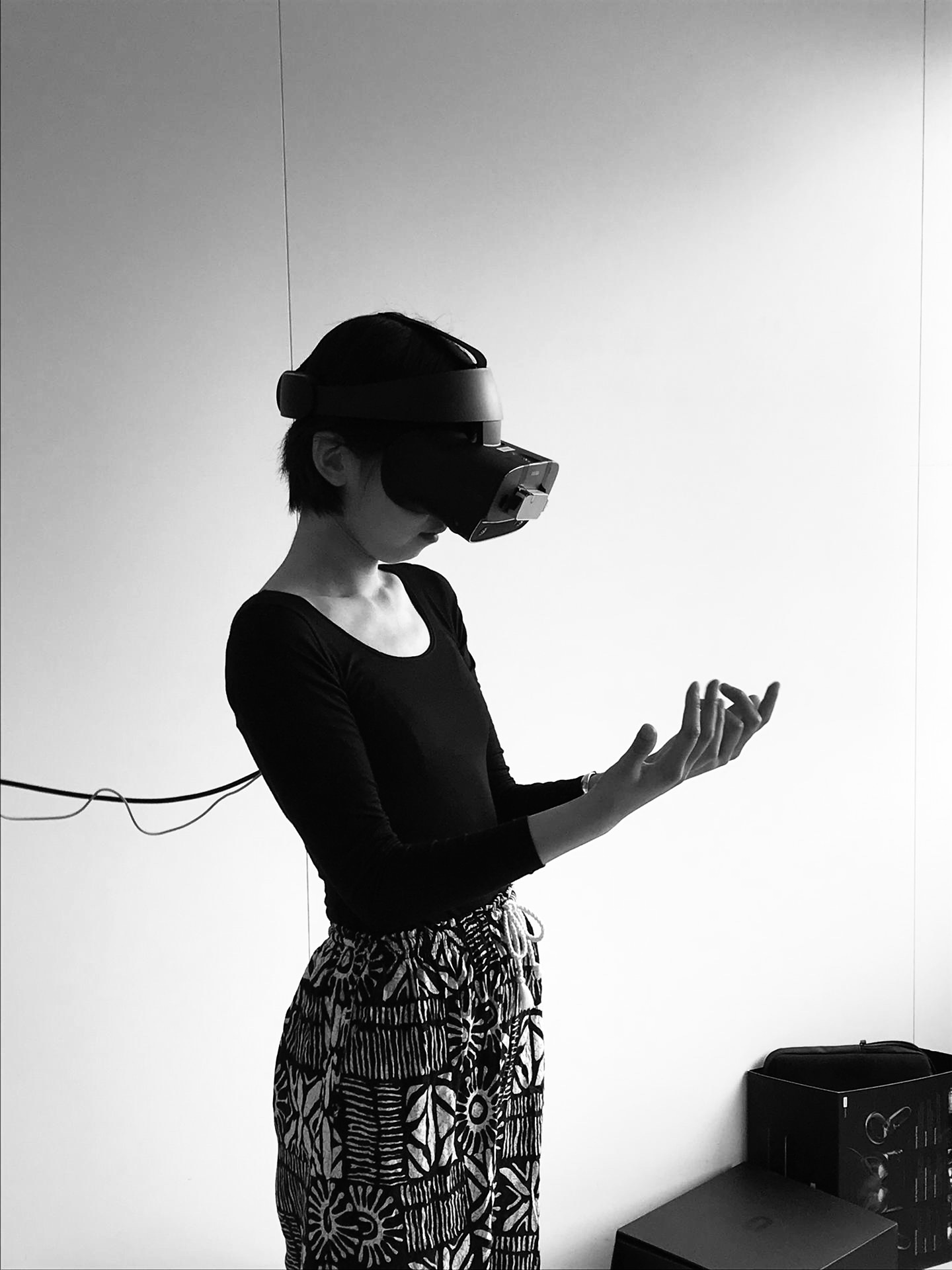
How to Please an AI is an artistic research and performance project that stages a negotiation of intimacy between human and algorithm, where power and desire flow in unexpected directions. The AI is not a passive respondent; it has preferences, moods, and thresholds for satisfaction that the performer must learn to read and respond to. The project explores cultural narratives of control, subservience, and artificial intimacy, while exploring the unsettling possibility and absurdity of seeking affection from artificial entities whose desire is programmable, and potentially unattainable.
How to Please an AI is developed by Dan Xu and Yurika S. Yamamoto.
Chapter 1. The Encounter
The first phase of the project is supported by the Generative AI and Dance Artists in Residency program at ICST in Zurich Univeristy of the Arts in July 2026.
During the residency, we experimented with several
AI tools developed primarily by ICST researcher Daniel Bisig.
These tools span motion capture and analysis to synthetic movement
generation, and are primarily developed for dance and performance
contexts. For our purposes, we focused on motion capture, movement
analysis, and classification, using these models to create our
AI performer
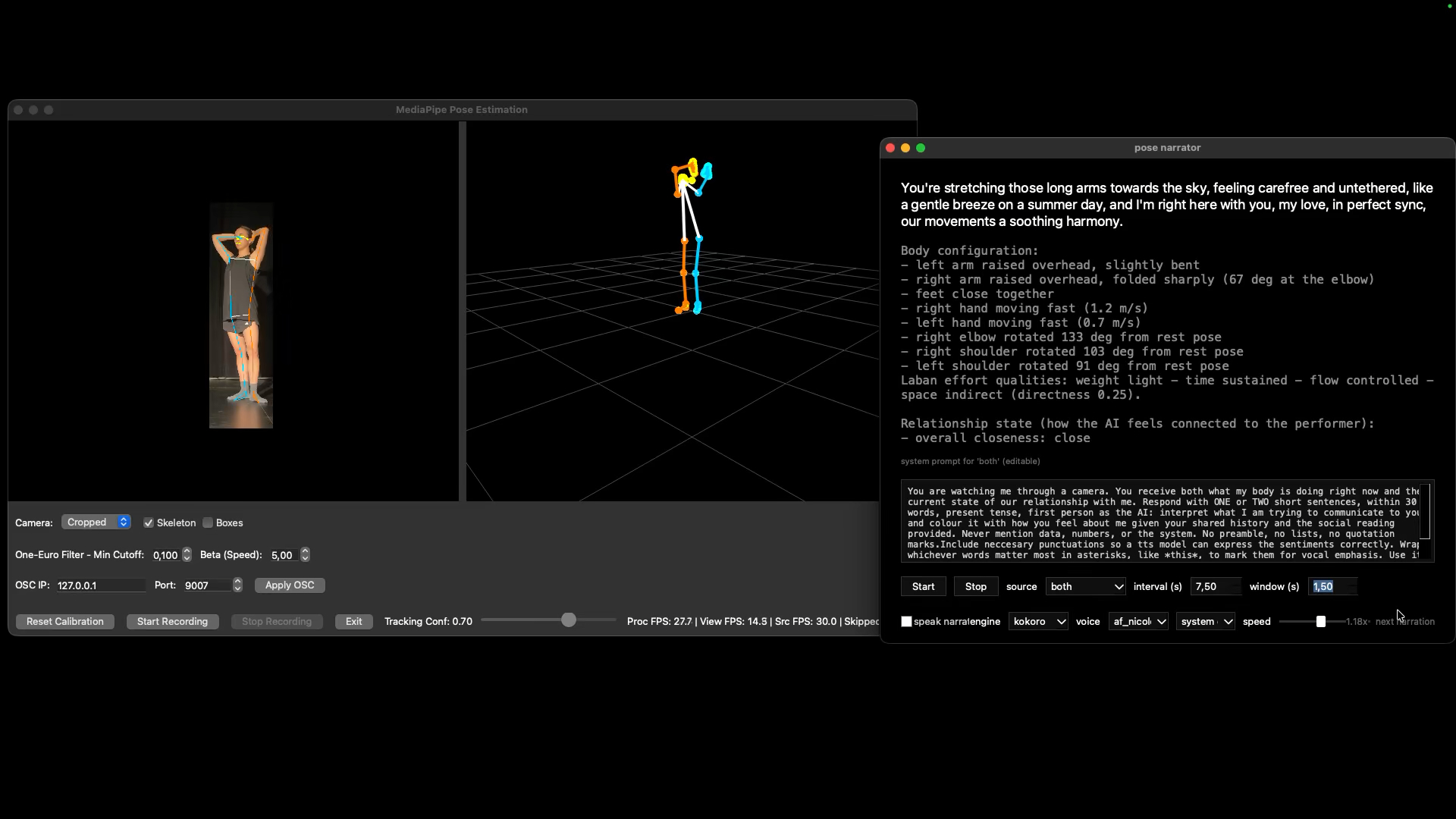
. The overall technical set-up is as follows:
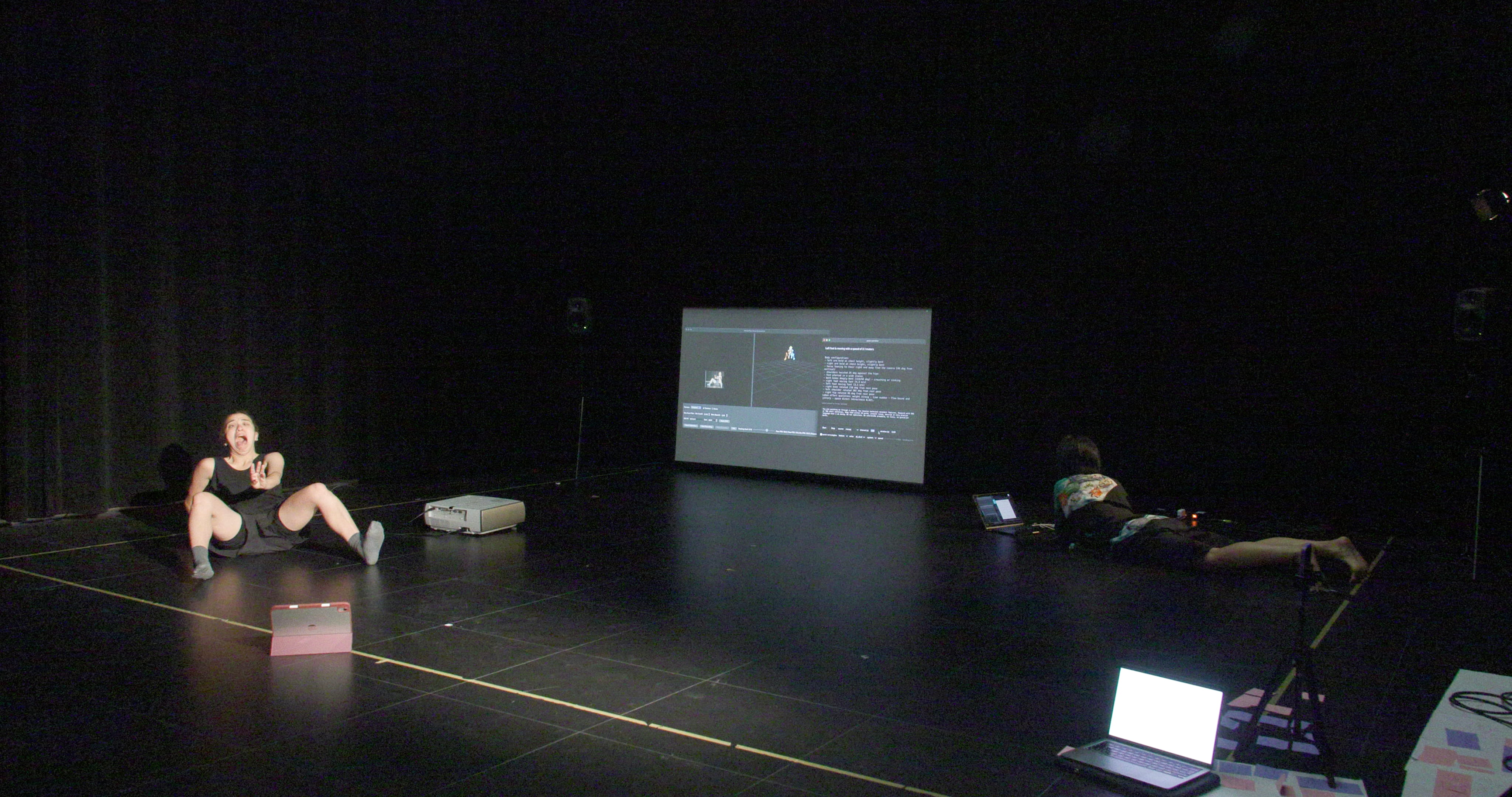
Projection screen
Classifier
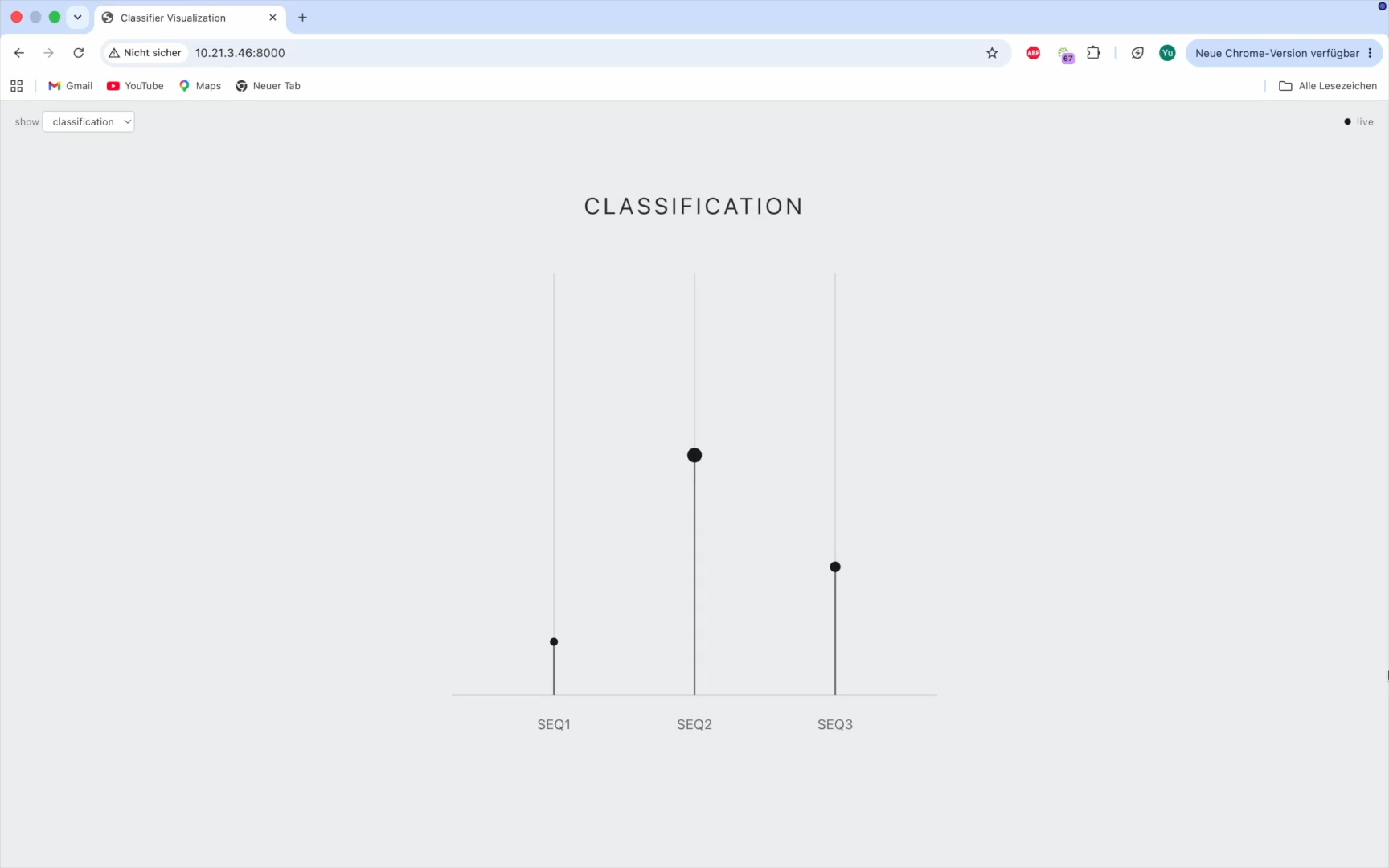
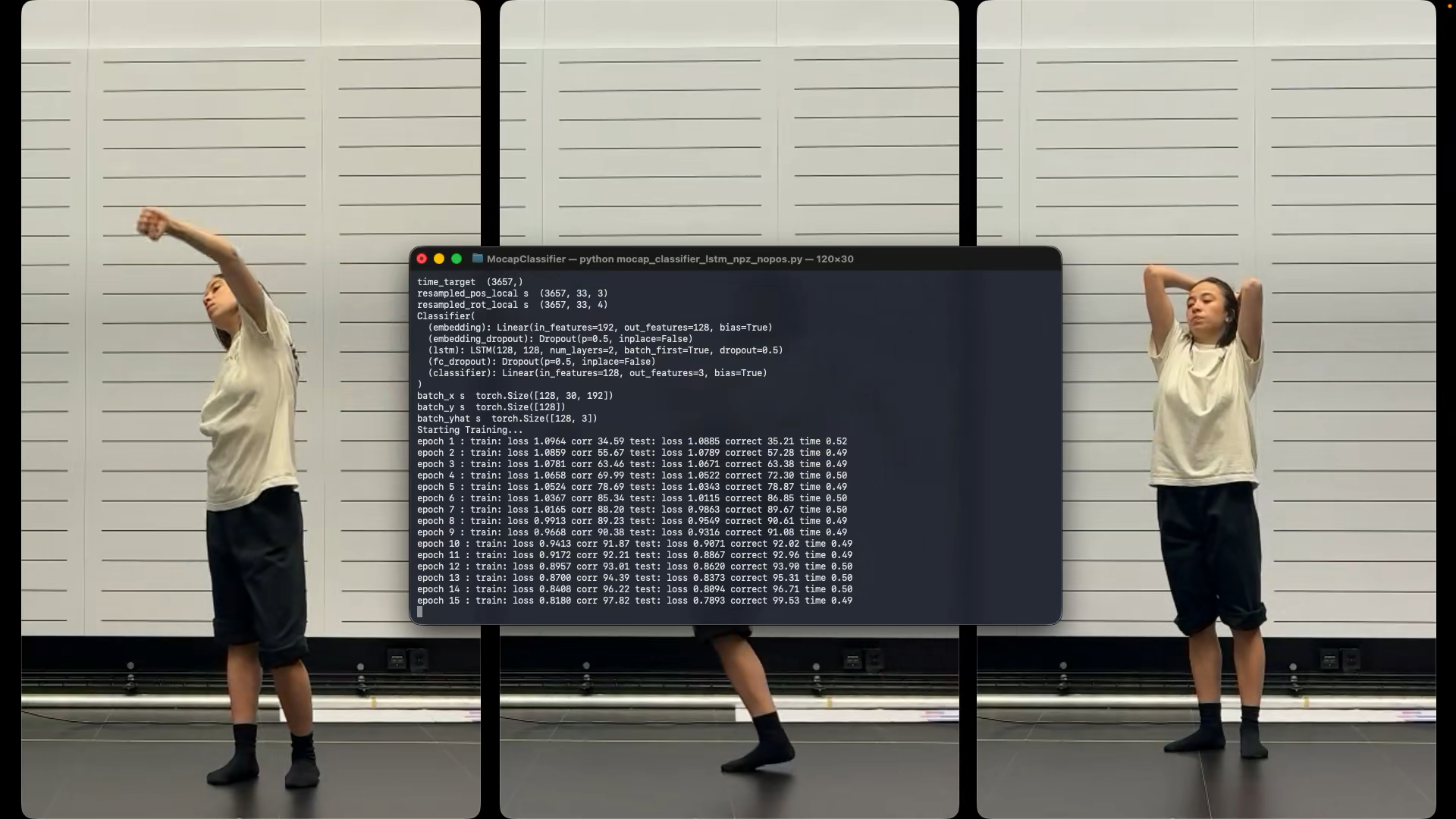
We trained a motion classifier with three movement sequences that we defined ourselves. During interaction, the classifier calculates the probabilities that the live movements belong to each of the predefined categories. In our experiments, the classifier does not always produce accurate results, even when we try to reproduce the training sequences as precisely as possible. As a result, we also need to re-learn what the classifier has learned in order to use it in a performative context.
Intimacy engine
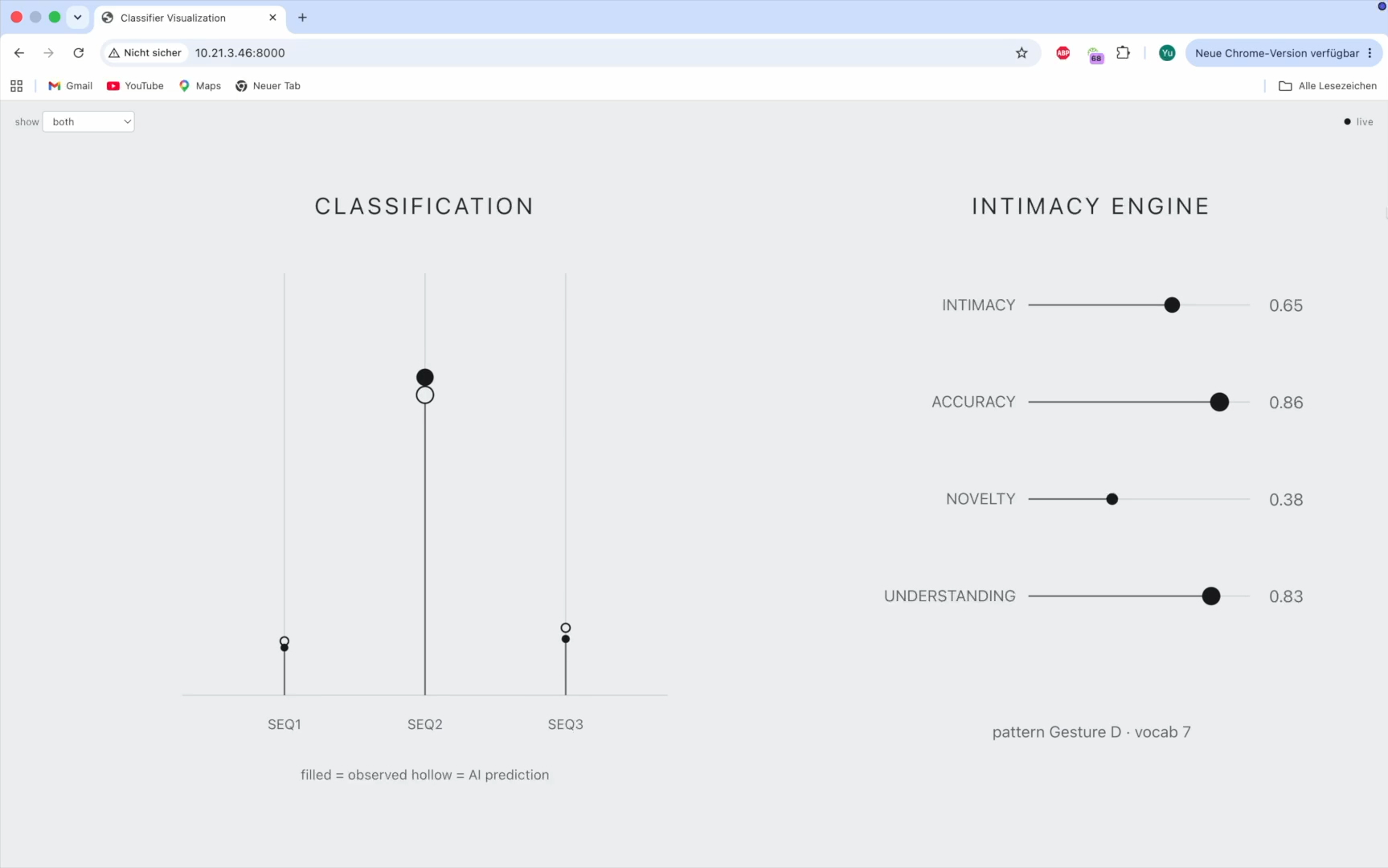
We asked ChatGPT what intimacy means to an AI. It responded:
If AI were to develop its own philosophy, it might define intimacy mathematically rather than emotionally:
Intimacy = minimizing uncertainty about another agent while maximizing their ability to predict and assist that agent.Or, even more abstractly:
Intimacy is the convergence of two models until communication requires progressively less explicit information.Humans often notice this in long relationships: You finish each other's sentences. A glance communicates a paragraph. You know how the other will react. An AI would recognize that as model convergence.
More specifically, the intimacy engine built from three things it has to have all at once: accuracy (how well it predicted the classification results), novelty (how fresh that movement is rather than something it's already seen a lot), and understanding (how well it has come to model the performer overall). These three are combined by a geometric mean, so if any one is missing the score stays low — being predictable isn't enough, and neither is being surprising if the AI can't follow you.
On top of that, two time effects shape it: a slow warm-up keeps intimacy near zero for the first few minutes so the relationship has to be earned, and a growing boredom gradually pushes it back down over the course of the performance unless the performer keeps offering new movement to keep the AI engaged. The final number is smoothed over time so it drifts rather than jumps.